

Commentary
For the Middle Corridor to fulfill its promises, one of these routes must become scalable. At present, neither is.
Friedrich Conradi
{
  "authors": [
    "Andrei Dagaev"
  ],
  "type": "commentary",
  "blog": "Carnegie Politika",
  "centerAffiliationAll": "",
  "centers": [
    "Carnegie Russia Eurasia Center",
    "Carnegie Endowment for International Peace"
  ],
  "englishNewsletterAll": "",
  "nonEnglishNewsletterAll": "",
  "primaryCenter": "Carnegie Russia Eurasia Center",
  "programAffiliation": "",
  "regions": [
    "Europe",
    "Russia",
    "China",
    "United States"
  ],
  "topics": [
    "Global Governance",
    "Security",
    "Foreign Policy"
  ]
}
Source: Getty
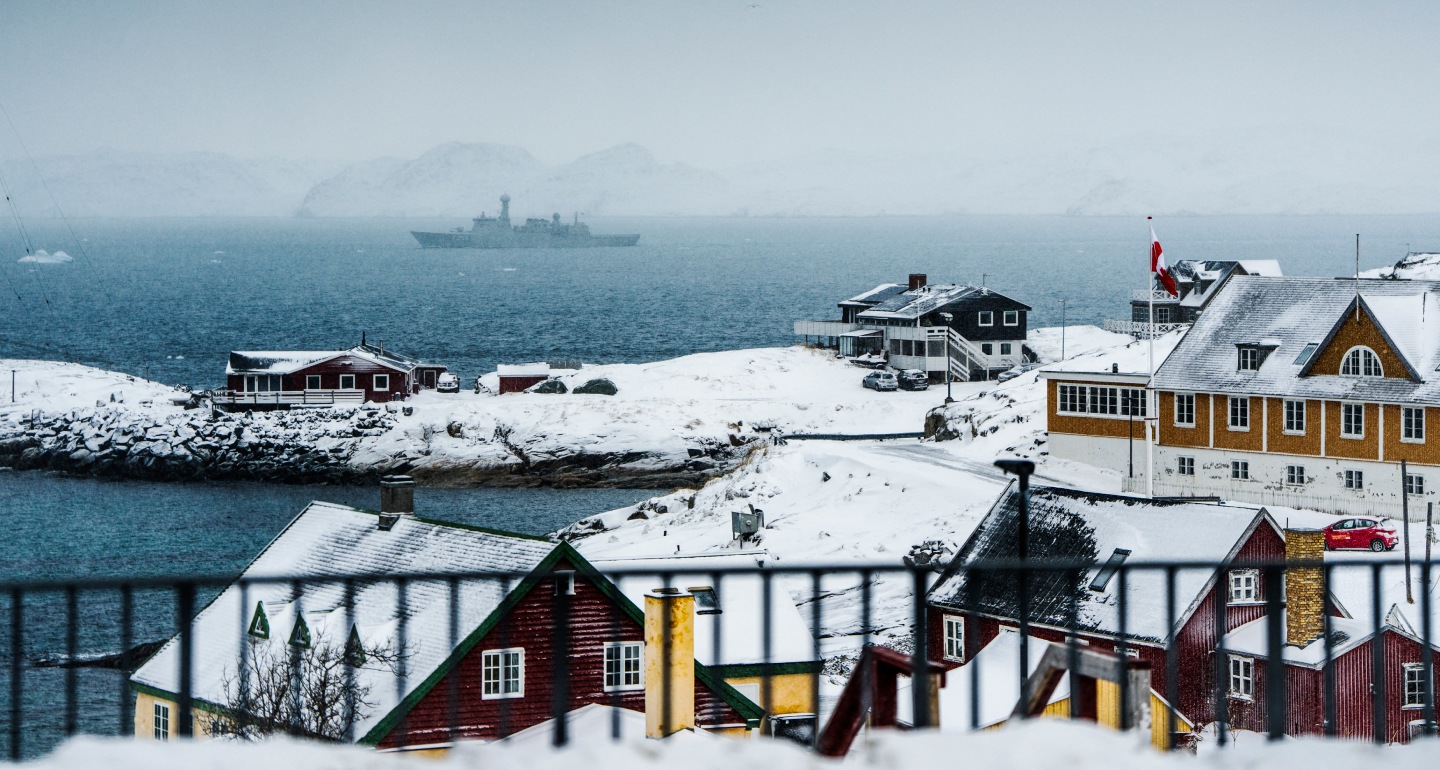
The supposed threats from China and Russia pose far less of a danger to both Greenland and the Arctic than the prospect of an unscrupulous takeover of the island.
Having previously only ever made headlines in the context of global warming, Greenland now finds itself at the center of the world’s attention as U.S. President Donald Trump explores ways to seize control of the island. The U.S. leader argues that such a move is necessary to prevent China and Russia from ramping up their presence in the Arctic to dangerous levels near the United States’ northern border. For now, however, Washington’s actions are proving more destabilizing than Moscow and Beijing’s extremely limited influence in Greenland.
Trump’s interest in Greenland is understandable. This self-governing territory of Denmark is a key geostrategic point, and as summer sea ice in the Arctic shrinks, Greenland will be at the intersection of potentially important shipping routes, including the U.S.-Canada Northwest Passage and the Transpolar Sea Route.
The island also possesses significant mineral reserves beneath the ice sheet. Retreating glaciers are opening up deposits of iron ore, graphite, tungsten, and other resources. Most importantly, Greenland has the world’s eighth-largest rare earth metal reserves, meaning it could become a vital link in supply chains for the high-tech and defense industries.
For the United States, Greenland could also serve as a northern defense line. The island already hosts the U.S. Pituffik Space Base, which tracks the trajectories of missiles launched toward the United States. But regardless of growing attention from the United States and other powers, Greenland has its own regional interests and visions for its future.
Denmark’s 2009 Act on Greenland Self-Government grants Greenland broad powers to manage its natural resources and a certain degree of international agency while reserving foreign policy and defense decisions for Copenhagen. Denmark actively uses the island to strengthen its status in NATO and the Arctic, but does so in close cooperation with the island’s capital, Nuuk.
The Arctic island’s goals were enshrined in a 2024 Arctic strategy policy document titled “Greenland in the World: Nothing About Us Without Us.” In it, Greenland’s authorities prioritized strengthening critical infrastructure, preventing the island’s further militarization, reducing regional tensions, and transforming the Arctic into a zone of peace. For these purposes, the current regional governance and security architecture suits Greenland.
The island’s main investment partners are Denmark, which provides subsidies, and the United States, which has a vested interest in military and economic development. The gradual resolution of boundary and shelf disputes is opening up opportunities for Greenland to expand cooperation with its closest neighbors—including Canada and Norway—on Arctic environmental protection, fishing, and scientific research. Neither China nor Russia can be considered key partners of Greenland.
China’s presence in Greenland is most often discussed in the context of critical mineral extraction there. In 2016, China’s Shenghe Resources bought a stake in the mining company Greenland Minerals and Energy, giving it the rights to extract rare earth metals and uranium at the large Kvanefjeld deposit in the south of the island. This was presented as an example of the prospects for attracting further Chinese capital in future.
However, a study of Chinese investment in the Arctic over the past eighteen years shows that not one of the potential mining projects involving the Chinese in Greenland has yet been realized. The Kvanefjeld deposit, where mining was banned in 2022 over environmental concerns, is no exception.
A similar fate befell the Chinese coal and iron mining company General Nice Development Limited’s acquired mining rights to the Isua deposit in the southwest of the island, along with a whole host of Chinese-financed gold and copper mining projects in Greenland. Reasons include low profitability, Danish export restrictions, technical problems, and a lack of infrastructure. Chinese involvement in Greenlandic investment projects is also limited by political pressure from the United States and Denmark.
Although China is at pains to emphasize the nonmilitary nature of its Arctic policy, Washington has long been concerned about Beijing’s presence in Greenland. The U.S. authorities fear that Chinese infrastructure poses risks to the United States’ northern border. In 2018, under pressure from the United States and Denmark, Greenland’s authorities rejected a proposal under which the Chinese would have built three airports on the island.
China remains open to cooperation with Greenland, but currently prefers to take a wait-and-see approach and avoid raising suspicions of having ulterior motives. In addition, Beijing lacks the capability and technology to maintain a military presence at such a great distance and in such challenging climatic conditions.
Russia’s Arctic policy doesn’t even mention Greenland separately from other countries. The focus is on Russia’s own Arctic territory and resources, and the development of the Northern Sea Route. Moscow advocates for the primacy of sovereignty in the Arctic and, like Nuuk, for the Arctic to be designated a zone of peace and cooperation.
In recent years, Russia has been accelerating its military buildup in its Arctic territory, recommissioning old military bases, strengthening its Northern Fleet, and creating new infrastructure. This has prompted concerns in Washington that a potential attack against the United States could come from this direction. The Kremlin, in turn, accuses NATO countries of militarizing the region.
Greenland and Russia mainly only interact indirectly within the framework of the Arctic Council. Before the war with Ukraine, there was some cooperation over fisheries, but after 2022, Russia’s dialogue with the other Arctic countries came to an abrupt halt.
Still, there are no signs that Moscow intends to turn the Arctic or Greenland into an actual front line. Russia’s policy in this area is evolving more toward defense and deterrence of Western military infrastructure.
As for Greenland’s interactions with the United States, which has long had an interest in the island’s resource and geostrategic potential, there are no really serious obstacles to this cooperation even without a formal annexation. The 1951 Defense of Greenland agreement grants the U.S. military not only the right to operate the Pituffik Space Base, but also to expand its presence into other territory upon notifying the Danish and Greenland authorities. In December 2025, Greenland’s Prime Minister Jens-Frederik Nielsen confirmed this right, meaning that ensuring security does not necessitate annexation.
The problems with Greenland’s mineral extraction are not so much related to sovereignty issues as to economic considerations. Annexing the island will not solve the high production costs, logistical difficulties, environmental impact, and so on.
Currently, Trump sees control of Greenland not only as a guarantee of American Arctic security, but also as the key to obtaining economic advantages. But in reality, the supposed threats from China and Russia pose far less of a danger to both Greenland and the Arctic than the prospect of an unscrupulous takeover of the island.
The latter would not only undermine the transatlantic partnership and set a very dangerous precedent for border revisions, but also end the principle of Arctic exclusivity, which guaranteed security and stability in the region even amid the major confrontation between Russia and the West.

Andrei Dagaev
PhD student at the National Chengchi University (Taipei)
Carnegie does not take institutional positions on public policy issues; the views represented herein are those of the author(s) and do not necessarily reflect the views of Carnegie, its staff, or its trustees.
For the Middle Corridor to fulfill its promises, one of these routes must become scalable. At present, neither is.

Friedrich Conradi

For Lukashenko, abandoning Western internet services and embracing Russian equivalents would mean tying himself even closer to Moscow.

Artyom Shraibman
Troubled by the growing salience of nuclear debates in East Asia, Moscow has responded in its usual way: with condemnation and threats. But by exacerbating insecurity, Russia is forcing South Korea and Japan to consider radical security options.

James D.J. Brown
The Russian state has opted for complete ideological control of the internet and is prepared to bear the associated costs.

Maria Kolomychenko

Powerful lobbyists and inertia led to Russia’s coal-mining sector missing an excellent opportunity to solve its structural problems.
Alexey Gusev