

Commentary
Zaur Shiriyev
{
  "authors": [
    "Zaur Shiriyev"
  ],
  "type": "commentary",
  "blog": "Emissary",
  "centerAffiliationAll": "dc",
  "centers": [
    "Carnegie Endowment for International Peace"
  ],
  "englishNewsletterAll": "ctw",
  "nonEnglishNewsletterAll": "",
  "primaryCenter": "Carnegie Endowment for International Peace",
  "programAffiliation": "russia",
  "programs": [
    "Russia and Eurasia"
  ],
  "regions": [
    "Armenia",
    "Azerbaijan",
    "Iran",
    "Caucasus"
  ],
  "topics": [
    "Security",
    "Foreign Policy",
    "Domestic Politics"
  ]
}
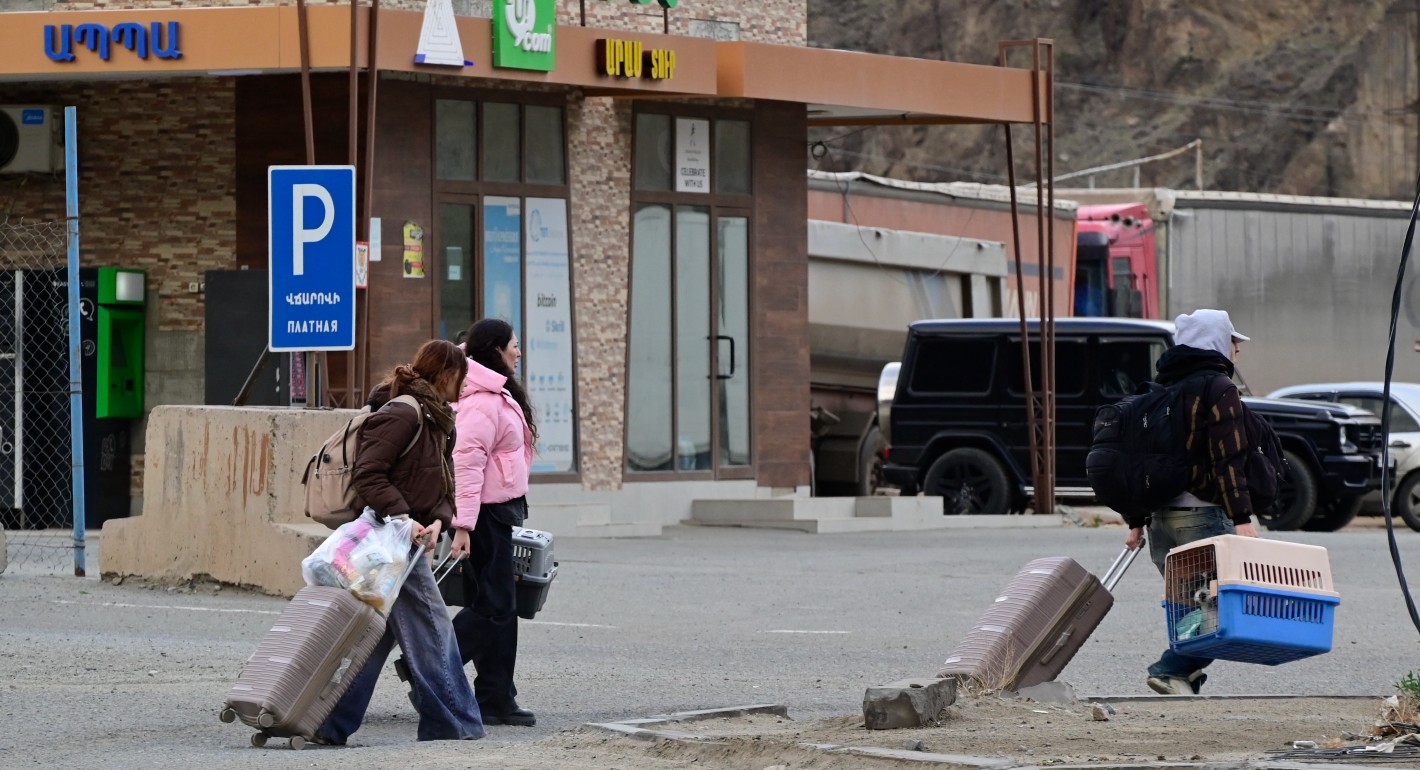
Iranian refugees cross the border into Meghri, Armenia, on March 8, 2026. (Photo by Karen Minasyan/AFP via Getty Images)
The conflict is threatening stability in Armenia and Azerbaijan.
As U.S. and Israeli strikes on Iran enter their third week, the shockwaves are already racing across its northern frontier, placing Armenia and Azerbaijan on the front line of regional instability.
In Azerbaijan, the consequences have already been tangible. On March 5, a drone launched from Iranian territory hit the airport and a school in its exclave of Nakhchivan, a day after the Azerbaijani president had visited the Iranian embassy in Baku to offer condolences for the death of the Iranian supreme leader. The incident quickly triggered a sharp escalation in rhetoric on both sides: Baku signaled readiness for a retaliatory response, while Iran’s Revolutionary Guard warned of a broader reaction. Yet the crisis de-escalated almost as quickly, after a direct conversation between the Iranian and Azerbaijani presidents. Iran has long expressed concern over Azerbaijan’s close security ties with Israel, which could be cited as a pretext for such actions, though the motive remains unclear.
The scars of the drone attack will remain, but Baku’s immediate rationale to obtain an explanation from Tehran—something that may only become possible once the broader war subsides—rather than retaliate was clearly an attempt to keep the incident from spiraling. Azerbaijan even sent humanitarian aid to Iran afterward. Part of this rapid de-escalation reflects the vulnerable position of Nakhchivan, whose air and land links depend heavily on transit through Iran. Civil aviation at Nakhchivan airport was briefly suspended after the strike but resumed within days. An alternative route via Turkey’s Iğdır province exists but is limited, and prolonged instability could revive reliance on routes through Armenia.
Economically, the war stands to deliver Azerbaijan substantial gains from higher oil prices. A sustained $20–$25 rise in Brent crude would generate an annual export windfall of roughly $6 billion to $7.5 billion (or $500 million to $600 million per month). Yet the benefits come with costs: Higher energy prices will feed imported inflation into an economy where nearly half of imports come from countries also hit by rising fuel costs. A potential refugee flow from Iran poses an additional risk, even with Azerbaijan’s borders currently closed.
For Baku, however, the deeper long-term concern lies not in transit routes but across its roughly 700-kilometer border with Iran: the fate of Iran’s ethnic Azerbaijanis.
Iranian Azerbaijanis, numbering more than 20 million, face a difficult choice and are often misread by outsiders. While extremist pro-regime loyalists and supporters of secession exist, they are not dominant, nor is the community uniformly aligned with the regime on how Iran’s future should unfold. Many view Iran as their own country and are represented across multiple levels of political, military, and economic decisionmaking. Since the election of President Masoud Pezeshkian, himself of Azerbaijani origin, many Iranian Azerbaijanis have hoped that long-neglected cultural and linguistic rights may receive greater recognition, which would strengthen the community’s sense of ownership within Iran rather than weakening it.
Baku, however, has made clear it will not join any war against Iran and firmly denies claims that its territory could be used for Israeli military operations. Last year’s twelve-day confrontation demonstrated that Israel and the United States can operate deep inside Iran without relying on Azerbaijani territory, undermining claims that Azerbaijan serves as a staging ground. In this context, the dynamics within Iran’s Azerbaijani population suggest that only a full collapse of the Iranian state would generate significant support for fragmentation—a scenario Baku recognizes as a major risk but one that would trigger active involvement only in the event of systemic breakdown.
Even then, the scenario would be double-edged. Other ethnic groups, particularly Kurds, could pursue their own territorial claims, including in areas of northwestern Iran, where Kurds and Azerbaijanis live intermingled. This could create new fault lines rather than resolve existing ones, potentially exposing ethnic Azerbaijanis to pressure or violence from competing nationalist forces. In such circumstances, Baku would face expectations, both domestically and among Iranian Azerbaijanis, to act as a protective power, even if direct involvement would carry serious risks. Turkey, strongly opposed to Kurdish separatism, would likely play a major role in managing these dynamics and could position itself alongside Azerbaijan as a security backstop for Azerbaijani populations in the region.
Precisely because of these risks, regime survival could represent the least destabilizing outcome for Iranian Azerbaijanis. Unlike some Kurdish factions, they have shown little desire to act as proxies of external powers and tend to resist such roles. If the state endures, their demographic weight and institutional presence could allow them to press more effectively for expanded cultural and political rights from within.
The latest from Carnegie scholars on the world’s most pressing challenges, delivered to your inbox.
For Armenia, the fallout from the conflict presents a very different set of challenges. Armenia shares only a short border with Iran, yet instability there and uncertainty about the ultimate goals of the U.S. and Israeli campaign create both opportunities and serious risks, especially as the country prepares for decisive parliamentary elections in June.
Economically, the most immediate impact is disruption of trade with Iran and partners further east, such as India. While not instantaneous, a prolonged war would bring higher energy and import costs, reduced trade flows, and rising inflation along Armenia’s only open southern route. At the same time, the disruption could encourage more structural cooperation with Turkey and Azerbaijan. Since last December Azerbaijan has supplied oil products to Armenia, and with energy prices rising, this interaction could gain strategic importance. Such cooperation could also gradually reduce domestic resistance in Armenia, where open protests are rare but discomfort remains due to the trauma of more than three decades of conflict.
Armenia’s outlook will also depend on humanitarian factors, including a possible influx of refugees. With Azerbaijan’s borders largely closed, Armenia could become a more attractive destination for settlement or transit for Iranians fleeing the conflict. This would add further pressure to the economy.
Politically, the timing is significant because the war coincides with the pre-election period. It may reinforce Prime Minister Nikol Pashinyan’s “Real Armenia” narrative, which emphasizes good-neighborly relations, a state confined to internationally recognized borders, moving beyond conflict with Azerbaijan and Turkey, and gradual distancing from Russia. By staying largely out of the fighting, the government can present its cautious foreign policy as effective and portray Armenia as carefully navigating the crisis ahead of elections.
The attacks on Iran, following earlier U.S. pressure on other Russian partners such as Venezuela, also strengthen the case for diversification away from Moscow. Russia’s allies are being targeted one by one, yet tangible support from the Kremlin has largely been limited to diplomatic signaling. This dynamic not only reinforces the strategic rationale for distancing Armenia from Russia but also boosts the government’s domestic position against pro-Russian opposition forces that argue closer alignment with Moscow is essential for security.
A prolonged war, however, also threatens a key shared interest of Armenia and Azerbaijan: the TRIPP project, a U.S.-backed transit route linking Azerbaijan with its Nakhchivan exclave through Armenian territory. Brokered by Washington in August 2025, the initiative is considered economically and strategically important for both countries, and a recent visit by U.S. Vice President JD Vance raised hopes for faster implementation. Continued war in Iran would likely delay progress.
Critics in Armenia will argue that major political change in Iran could weaken the project’s geopolitical rationale and reduce U.S. interest, as a pro-U.S. Iran would diminish its strategic logic. Conversely, prolonged instability or regime survival in Iran could make the route more necessary for both countries as an alternative transit option in an increasingly fragile regional environment.
In the end, the project’s future—and much else in the South Caucasus—will hinge on developments inside Iran.

Nonresident Scholar, Carnegie Russia Eurasia Center
Zaur Shiriyev is a nonresident scholar at the Carnegie Russia Eurasia Center.
Recent Work
Zaur Shiriyev

Zaur Shiriyev, Philip Gamaghelyan
Carnegie does not take institutional positions on public policy issues; the views represented herein are those of the author(s) and do not necessarily reflect the views of Carnegie, its staff, or its trustees.

The conflict is exposing the deep energy vulnerabilities of Korea’s chip industry.


Darcie Draudt-Véjares, Tim Sahay
Even if the Iran war stops, restarting production and transport for fertilizers and their components could take weeks—at a crucial moment for planting.

Noah Gordon, Lucy Corthell
The recent record of citizen uprisings in autocracies spells caution for the hope that a new wave of Iranian protests may break the regime’s hold on power.


Thomas Carothers, McKenzie Carrier
If the succession process can be carried out as Khamenei intended, it will likely bring a hardliner into power.

Eric Lob
But to achieve either, it needs to retain Washington’s ear.

Alper Coşkun